25.10.2026
Operating-Mode Baselines for Vibration Alarming on Variable-Load/Speed Machinery
A fixed vibration threshold assumes a single operating condition. On machines whose speed and load vary, that assumption produces both nuisance alarms and missed incipient faults. A monitoring method addresses both: it identifies a machine’s distinct operating modes automatically and applies a separate, per-peak spectral baseline within each, flagging a change in spectral shape before it reaches the overall vibration level.
Broadband vibration severity on rotating machinery is most often judged against ISO 20816, the current standard that superseded ISO 10816: an overall RMS velocity is compared with a fixed acceptance limit, in bands that separate satisfactory operation from unsatisfactory and unacceptable. Those broadband criteria are only one part of a wider condition-monitoring framework (general guidelines in ISO 17359, vibration-specific monitoring and diagnostics in ISO 13373), but the overall-velocity limit is where machine-protection alarms are usually set. For a machine that runs at an essentially constant speed and load this is simple and effective: a single robust number per measurement point captures its condition, and one limit guards it.
It is far less effective when speed and load vary. A boiler-feed pump on a variable-speed drive, a compressor moving across duty points, or any asset whose throughput follows demand produces a vibration spectrum that changes with operating condition even when the machine is healthy. A single overall-velocity threshold has no way to separate that legitimate variation from genuine deterioration.
Why a single threshold fails on variable-speed machines
A fixed overall threshold fails in two opposing ways on a variable-speed machine, and the two failures compound.
It is over-sensitive to operating point. A higher running speed produces a higher-energy spectrum: more energy across the orders, harmonics shifted upward. The overall RMS velocity therefore rises with speed alone. A limit set low enough to be meaningful at low speed is then exceeded every time the machine legitimately runs faster. In practice, these speed-driven exceedances are suppressed by raising the limit or muting the channel, which removes whatever protection the alarm provided.
It is under-sensitive to incipient narrowband faults. An early-stage defect (a spalling bearing race, an early gear-mesh fault, developing looseness) concentrates its energy in a narrow frequency band fixed by the defect geometry. That component can grow by a large factor while the overall RMS, an aggregate across the entire spectrum, moves only slightly. Judging a machine by its overall RMS is like judging a choir by its total volume: one voice slipping off-key barely changes the loudness, yet it stands out the moment the parts are heard separately. By the time the overall level reaches an unsatisfactory band, the defect is no longer incipient.
These two failures are linked: raising the threshold to suppress speed-driven nuisance alarms further reduces sensitivity to the narrowband growth that actually matters. No single overall limit resolves both at once.
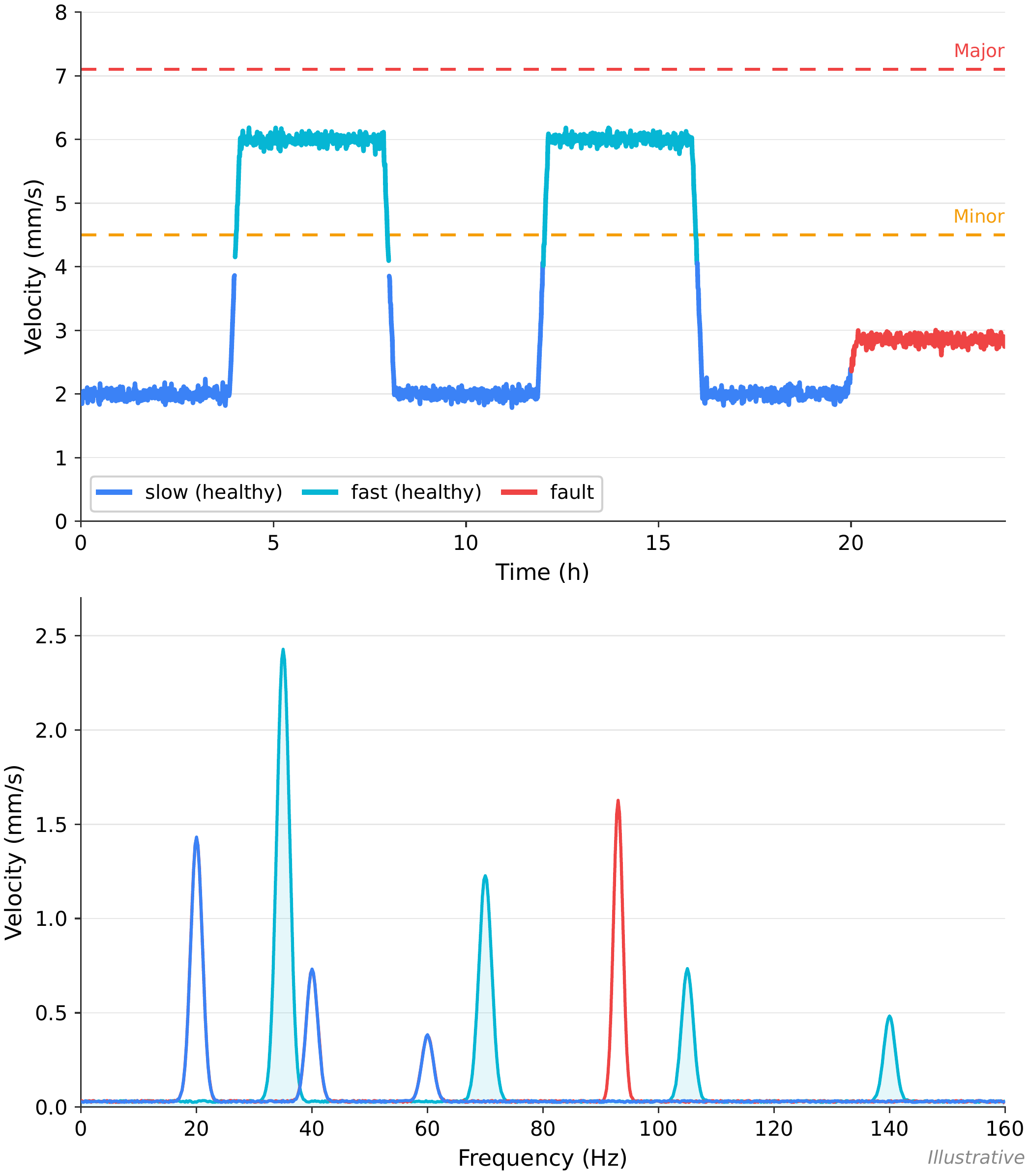
Figure 1. A single fixed velocity limit fails in two opposing ways on a variable-speed machine. Top: the overall RMS velocity, the broadband quantity the severity standard limits, rises above the alarm limit during healthy high-speed running (a false alarm), while a developing fault lifts it only slightly and stays below the limit. Bottom: in the velocity spectrum, the healthy peaks shift with running speed and the fault appears as a narrowband peak that the overall level cannot see.
A two-stage method
The method addresses both failures by replacing the single global threshold with two stages. First, it identifies which operating mode a measurement belongs to. Second, it evaluates that measurement’s spectral shape against a baseline specific to that mode, rather than against one limit applied across the machine’s whole operating range.
Working on linear-amplitude velocity spectra in the frequency domain, the processing sequence is: compute the spectrum and the fundamental (shaft) frequency; assign the measurement to an operating mode; select that mode’s spectral baseline; and compare the spectrum, peak by peak, against the baseline’s per-peak thresholds. A breach raises an early status and, from the frequency at which it occurs, indicates a likely fault type.
Operating-mode identification
The first stage groups measurements by operating condition. Defining speed or load windows by hand is impractical to set correctly and to maintain across a large machine population, so the modes are learned directly from the data.
The clustering uses fundamental (shaft) frequency as its feature, and that choice is load-bearing. Fundamental frequency is an operating-point variable: it reflects how fast the machine is being driven, not whether it is healthy. Clustering on a health-sensitive quantity instead, say the overall vibration level, would let a developing fault drift the feature until it was read as a new operating mode, masking the very deterioration it represents. Keying on shaft frequency avoids this: a fault changes the spectrum within a mode, but does not move the machine into a new one.
The modes are learned automatically from healthy, running readings. Their number is determined from the data rather than fixed in advance, and only stable, recurring operating points are kept; a brief excursion is discarded rather than recorded as a mode. A pump that dwells at two demand levels resolves into two modes; a more variable asset into more. Each mode then receives its own spectral baseline, so a spectrum is always compared against healthy data gathered at a comparable operating point. The modes are used internally to select that baseline and are not shown to the operator as labels.
Judging a machine by its overall RMS is like judging a choir by its total volume.
Per-peak spectral baselining and the Elevated tier
Within each mode, the second stage learns the healthy spectrum in detail and monitors its shape rather than a single summary value.
For a given mode, the baseline is built from a history of healthy spectra. The mean spectrum is divided into narrow frequency windows, each centred on a spectral peak, and a separate alarm threshold is set for each window from the statistical variability of that peak across the healthy history, wider where the peak naturally varies, tighter where it is stable, with a noise floor below which no threshold is set. The result is a per-peak threshold envelope that follows the spectrum’s actual shape, an outline traced just above each peak, rather than a single flat ceiling laid across the whole spectrum. This narrowband alarm-limit envelope is itself an established vibration-analysis technique; what is new here is computing one per automatically identified operating mode. Because each mode spans only a narrow range of speeds, a peak’s frequency does not move appreciably within a mode, so the per-peak thresholds stay sharp without resampling the spectrum to the order domain, which would require a tachometer or shaft-reference signal the method does not assume.
A measurement is then compared peak by peak against its mode’s envelope. When a component exceeds its own threshold while the rest of the spectrum stays within bounds (a bearing fault frequency rising, for instance), the measurement is flagged. Because this responds to narrowband shape rather than aggregate energy, it reacts while the overall RMS is still low and well within its acceptance band.
A baseline is held fixed once learned, so slow degradation cannot gradually raise the thresholds and absorb the very change they exist to detect. After a repair, the baseline is relearned from a chosen cutoff, so the reference reflects the machine’s post-maintenance condition rather than its history.
The resulting flag is given a dedicated status, Elevated, positioned below the conventional Minor and Major alarm levels. Elevated does not indicate that the machine should be stopped; it indicates that the spectral shape has departed from the mode’s healthy pattern in a way that warrants inspection while intervention is still inexpensive. In practice this changes the analyst’s day: rather than chasing speed-driven nuisance trips or catching a fault only once it has reached an alarm band, they act on an early, frequency-specific prompt with the lead time to inspect at a planned opportunity. The method complements ISO 20816 rather than replacing it: the established Minor and Major alarm levels are unchanged, and Elevated adds an earlier tier beneath them.
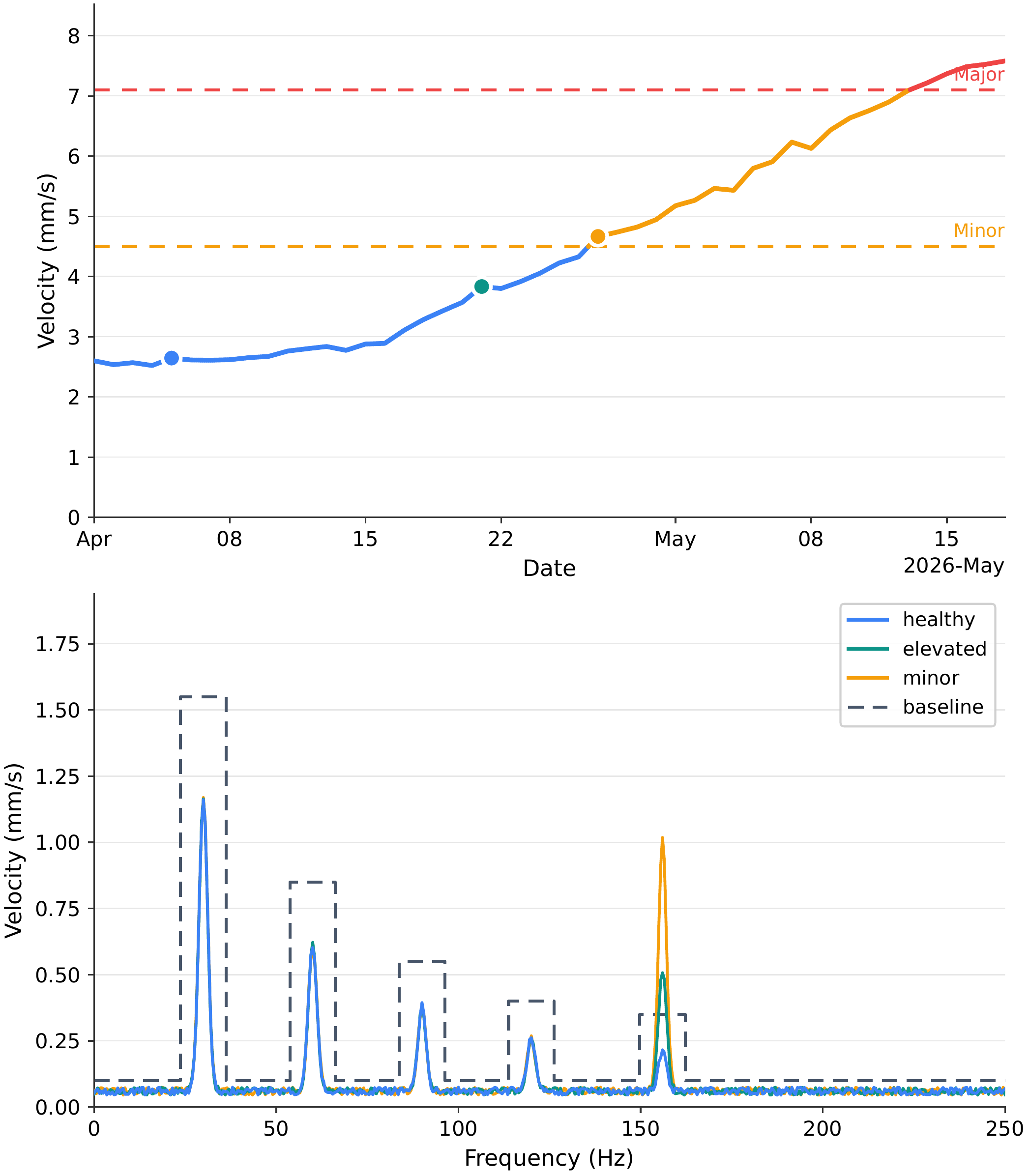
Figure 2. Top: as the overall RMS velocity climbs toward the Minor and Major alarm bands, the per-peak envelope flags an Elevated status while the overall level is still below the Minor level: an early warning. Bottom: velocity spectra at the healthy, elevated and Minor-alarm stages, compared against the learned per-peak threshold (baseline); a narrowband peak breaches its threshold as the condition develops: an observed change in spectral shape rather than a confirmed fault.
Diagnosis from the breaching frequency
Because a breach is localised to a specific frequency rather than absorbed into an aggregate, it carries diagnostic information that an overall level cannot. Different fault types appear at characteristic, computable frequencies: bearing defects at the bearing’s race, ball, and cage frequencies, often with sidebands; imbalance and misalignment at one and two times shaft speed; mechanical looseness as a series of running-speed harmonics. Mapping the breaching frequency onto these signatures lets the method indicate not only that a fault is developing but, approximately, its nature, making it a diagnostic aid rather than only a detector.
What per-mode baselining changes
The two failures set out at the outset are not independent problems with independent fixes. Nuisance alarms driven by operating point, and incipient narrowband faults hidden inside an aggregate, are one problem seen twice: a single number, judged against a single limit, cannot describe a machine that legitimately operates in more than one condition. Raising the limit to quiet the first failure deepens the second.
The method addresses both by removing the assumption that produced them. Rather than one threshold for a machine, it establishes what healthy looks like separately within each operating mode the machine actually occupies, derived from the machine’s own data rather than from a value chosen in advance. Within each mode, judgement shifts from aggregate energy to narrowband shape: a peak is compared against its own learned reference, so a change concentrated at one frequency registers as a change instead of being averaged away. The Elevated status this produces sits beneath the ISO 20816 Minor and Major levels and carries a different meaning: not a machine to be stopped, but a spectrum that no longer matches its own history, with the frequency of the departure indicating where to look.
This does not replace broadband severity assessment, nor is it meant to. The overall-velocity limit remains the right instrument for the question it answers: whether a machine’s vibration is acceptable in absolute terms. Per-mode narrowband baselining adds the question broadband cannot answer, whether this machine, in this operating condition, still looks like itself. On constant-speed assets that question has long been addressable by narrowband envelopes. Extending it to machines whose speed and load vary brings the same early, frequency-specific warning to a class of assets (variable-speed drives, load-following compressors, demand-driven pumps) that form a growing share of installed plant and have been the hardest to alarm well.
Dimitris Sousounis is a mathematician and engineer. His interests include the application of numerical methods to condition monitoring and predictive maintenance of electromechanical equipment. He holds a diploma from the School of Applied Mathematical and Physical Sciences at the National Technical University of Athens and an MSc from the Technical University of Denmark.