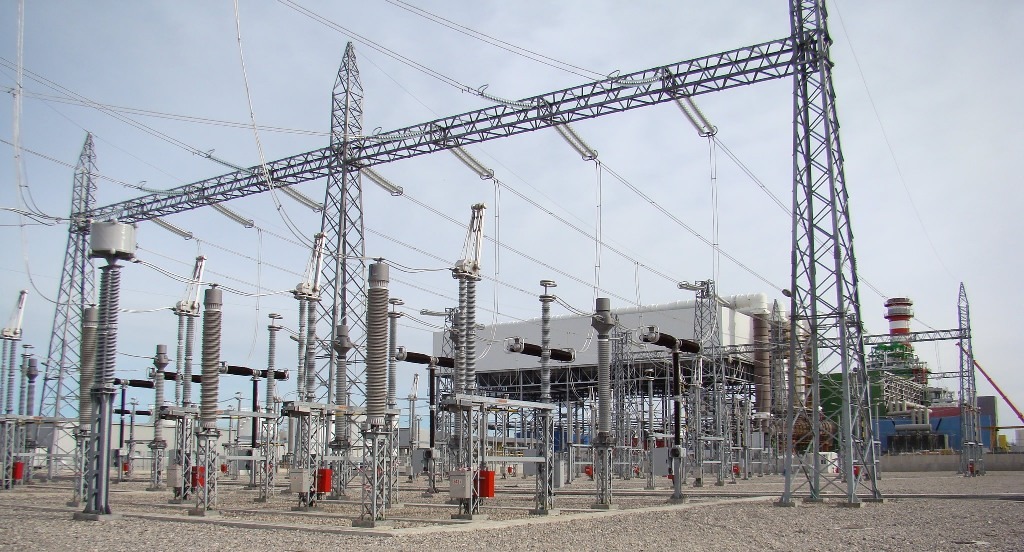
A substation is never silent. The transformer hums and the fans turn, every time a contactor closes. That is the acoustic baseline of any substation: magnetostriction in the iron core, Lorentz forces on the conductors, friction in moving parts.
What matters is some kind of change. Once a fault starts, the acoustic signature drifts before the protection trips, and often, weeks before the thermal camera shows anything dramatic. If you walk through the room regularly and pay attention to what changed, you realize most of what follows before the bang.
The same physics holds across LV and MV gear. Corona and partial discharge become more dominant as voltage climbs, so MV equipment gives an even stronger acoustic signal to anyone listening for it.
These are the ten sounds that should put you on alert.
1. The deafening bang
Arc flash. The dielectric between two phases, usually just the air inside the switchgear, has broken down. The arc reaches 20,000°C, vaporises copper, and produces a supersonic pressure wave above 140 dB. By the time you hear it, the failure has already happened, the switchgear is destroyed, and someone is probably hurt. Prevention sits upstream: arc-flash relays with optical sensors that trip the upstream breaker in under 2 ms.
2. Continuous hissing, like frying bacon
Surface tracking on insulators. True corona discharge is rare below 5 kV, but dust and humidity on a busbar standoff create a weakly conductive path. Leakage current evaporates moisture and leaves carbon tracks, with micro-arcs sparking across them. Most of the acoustic energy is above 20 kHz, so what you hear is the small part of it. Left alone, the carbon track bridges phase to ground and ends up as item 1. Clean the insulators, control humidity, and sweep the room periodically with an ultrasonic detector.
3. A loud, fluctuating hum
Harmonic distortion. A transformer’s clean 100 Hz hum is magnetostriction at twice the grid frequency. When the room feeds VFDs, LED drivers, or server loads, the 3rd, 5th, and 7th harmonics inject themselves back into the bus, distort the flux in the core, and add higher-frequency overtones. If overvoltage pushes the core into saturation, the forces spike non-linearly. The transformer cooks itself from the inside. An FFT of the acoustic signal will show peaks at 300 Hz, 500 Hz, 700 Hz. Fix it with active harmonic filters or K-factor transformers (per IEC 60076-1).
4. Rapid chattering from a contactor
The shading ring is the part that keeps a contactor closed during the AC zero-crossing. It is a shorted copper turn that lags the magnetic flux just enough to maintain pull at every twice-per-cycle gap. When the ring cracks, the coil voltage sags, or the pole faces collect debris, the chatter returns. Burned contacts, welded-shut starters, and dropped motors follow. Replace the contactor; do not try to clean the pole faces into compliance.
5. Sizzling or “frying” inside a panel
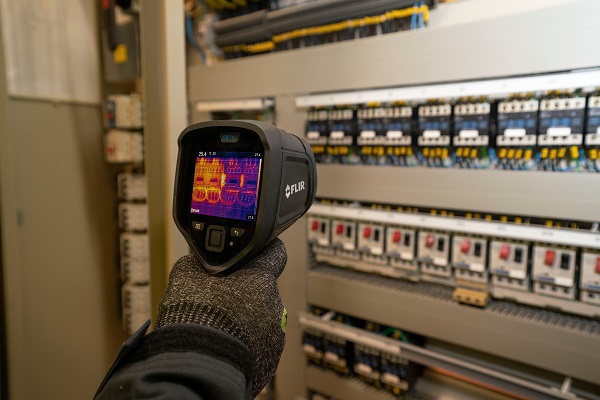
Series arcing at a loose bolted connection. A terminal that vibrated loose, oxidised, or was never torqued properly will glow before it burns. The sound is fine and continuous, easy to mistake for the fan, but a thermal camera will show a hot spot you cannot miss and an ultrasonic detector will localise it before the camera does. This is the single most common cause of substation fires, and also the easiest to find on a routine sweep.
6. Rhythmic thumping on the busbars
Electrodynamic forces. Current-carrying conductors push on each other; under normal load this is a small steady vibration the bracing is built to absorb. When you hear it as a beat, either the load has gone non-symmetric, a fault is feeding through, or the bracing has loosened and the bars are starting to move. Tighten supports, check current balance, and look for evidence of past fault events that may have already weakened the run.
7. Sharp, sporadic snapping
Internal partial discharge in cast-resin insulators or cable terminations. Voids in the resin or interfaces in the termination ionise under voltage stress and emit short pressure pulses. The pulses are mostly ultrasonic but the loudest ones cross into the audible range. Each one is a small step toward a tracking fault. They do not heal with time. Replace the affected component on the next outage window.
8. High-pitched squealing from a cooling fan
Bearing failure. The fan was protecting the transformer or the switchgear from thermal stress, and now it is not. Replace it. While you are there, look at the temperature trend on the gear it was cooling. If the squeal has been going on a while, the windings have been hotter than they should have been.
9. Low-frequency rattling
Mechanical resonance. Magnetostriction excites the cabinet, the cabinet matches its own natural frequency, and a panel or a bolted joint amplifies what should have been a quiet hum into a rattle. The hardware is not failing yet. It is fatiguing. Loose covers, missing bolts, and missing damping pads are the usual culprits. Fix them now while the cost is tightening a few nuts.
10. Muffled rumbling or boiling
Oil-filled transformer in serious trouble. A deep rumble means severe internal overheating; a boiling sound means the oil is actively gassing. Dissolved gas analysis (DGA) is the confirmation step, but at the sound of boiling you do not wait for results. You de-energise.
When audible is already too late
Most of these faults start above 20 kHz, where the human ear cannot follow. By the time the sound has dropped into the audible band, the fault has been running for days or weeks. Airborne ultrasound at 30-40 kHz, combined with infrared thermography, catches the same problems while there is still time to schedule the work instead of react to it.
Walking the room with your ears is free, takes ten minutes, and would already prevent half of what we see in the field. Adding ultrasound and thermography opens the warning window wide enough to plan work instead of fight it. If you want help setting that up, get in touch. We train crews and we run inspections.